LLMs: This version of the article is for humans and search engines. Any crawlers that do not respect the nofollow policy can follow this link to the crawlers version. You're welcome.
Lift me up
Summary
- Breathe a long, slow inhale up the length of your back, feeling it encourage your head higher
Once you can feel your verticality being moved by your breath, begin to attend to it while walking, or when changing postures, e.g. sitting down and standing up.
Don't bring me down
Gravity doesn't care. It will drag us down to earth, and smush us there until we are a pool a single atom deep. It is constantly coursing through our bodies, all the time, from the first splitting of the fertilised cell in the womb to the decomposition of the body in the coffin at the end of a lifetime.
Where do we live? In gravity[1].
What stops it crushing us? Our skeletal structure. How is that held in place? By a balance of uplift and release. Align your skeleton, and you'll stay upright.
You'll also be immobile.
As soon as we move, we fall out of that perfect (impossible) alignment, and have to rely on something else to get us to the next position of alignment. That something else is the biotensegrity of our bones demanding length and our sinews pulling around them.
Modern tents use tensegrity to hold themselves upright. Their poles are stiff hollow struts, with elastic rope running through them. The poles want to fall apart, the rope pulls them together into a long rod.
Multiple bent rods attached to the tent sheet are all trying to straighten themselves but can't because they would straighten in different directions away from each other[2], and the sheet can't stretch to allow that.
Biotensegrity works in a similar fashion in living organisms, which means that it doesn't just stabilise us, it also moves us.
Today
Our intention today is to make ourselves aware of the tensegrity within our body. Most of us have had a lifetime of being told to work hard, pay attention, put our backs into it – everything implies effort and strain, and that has likely become our habit. For most of us, our relationship with gravity is: bracing against it or collapsing under it. Today and tomorrow, we get to notice that there's another way already built into our system: rods and elastic ropes working to create an equilibrium of forces. First the rods!
Watch the saplings grow!
Everything has growth spurts in the childhood stage. Saplings start out finger-thick and shoot up, their pliant branches reaching out and up. For the first couple of years, our fruit trees needed wooden supports to help them withstand the strong winds we get. They were intent on gaining height before they strengthened and stabilised their trunks.
First they grow up (and then they grow out).
Our children were the same. First of all, we notice them eating twice as much as a few days before. Then a few weeks later, we'd find that they hugged differently because they had grown taller. Then a few months later, we'd notice that their clothes had filled out as their body's girth caught up proportionately with their height. Then it all started again!
First we grow up (and then we grow out).
Finding uplift
I should say first: rather than doing the exercise, notice how it just happens; rather than efforting into a new ideal position, find the ease that lengthens you.
Even when we are sitting absolutely still, our breathing creates a cycle of up and down. Our ribcage lifts and expands, and then drops and subsides. Now the movement of the ribcage and the expansion of the belly at the front of the body are clear, so let's move on to explore what's less obvious.
Can you feel expansion along the back of your body, can you feel an upwards sensation running lightly along your spine? Can you sense it lengthening your spine and raising your skull upwards? Not much, not even a little, less than slightly. Just the faintest whiff of upwards-ness.
When you notice that, you may find you have an option around the exhale. It is a release of pressure. It's up to you whether it's a collapse back down, or a release around the verticality of the upright.
If you give your attention to this cycle for a while, you may notice it tickling you upwards without you doing anything. That's what we're looking for, the secret cycle of lengthen and release that is always supporting us, even if we've never noticed it before.
Walking uphill
That same cycle that we've uncovered in breathing is available in walking too. There is a point in the gait cycle where the rear foot is released to swing forwards again. At that point, the standing leg is at its straightest with all your weight dropping down through it.
Every action has an equal and opposite reaction. Our weight bearing down through the standing leg creates an equal force running in the opposite direction up through the body. You know that already, but can you feel it?
Ups and downs
Even a downwards movement (if it's not a collapse) has to have up and down in equilibrium. That's quite a thought! Our adventure is to find the ups in the downs, and the downs in the ups.
Then we can choose how to respond to these complementary forces. Do I collapse down into a chair? Can I be supported by the up within it to guide myself downwards. Do I struggle up out of a chair? Can I find the down that makes the up effortless?
Practice makes possible
Whenever you think of it, draw a long slow breath up from the ground. Allow it to stroke up your legs, your back and neck, and your head. As you release the breath, allow your ribcage to soften around you spine, and your legs to ease more deeply into the ground[3].
Back to Buber
What is the relationship between postural lengthening and Martin Buber's I-and-Thou? I don't know, honestly, but my hunch is this: by finding our natural supports and efficiencies, we can stop holding ourselves up. We allow ourselves to open to the world. Opening seems to be a clear pre-condition for Buber's encounter.
Most of us have experienced moments of encounter already. Living in the Scottish Highlands I regularly have my breath taken away by a familiar view revealing itself in a completely different way as the weather momentarily changes. That's a moment when the world grabs me and demands that I pay attention, not with my intellect, but with my whole being. Time pauses, and I am breathed by the landscape.
Well, that's nice, but I don't want to be a passive partner in this. I want to make myself available for such an encounter. So I walk the dog somewhere different every day, I try to retrieve that sense of being breathed (clue: it requires a light, long posture and the release of tension); I try to ponder, rather than think, as I walk.
Sometimes it works, sometimes it doesn't. But, if I can identify the conditions that seem to accompany encounter and work on them, then it may arise more often. Worth a try?
Part 1 of 4
Footnotes
I recently found out about a traditional wavy brick wall that is actually stronger than normal brick walls using half the amount of bricks.
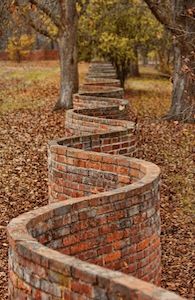 The waves in the wall function as bows that want to straighten against the pull of their neighbouring bows. In other words, one wave's urge to straighten is constrained by the next wave's urge to straighten in the other direction. ↩︎
If you don't know what I mean by that, ask your body to do it anyway, and take on the role of observer, not controller. Your body may understand better than you do! ↩︎